


Is Concept Art a Science?
At first glance, art may seem to be about creating "pretty images," and not much of a science, but design is the foundation that makes or breaks a piece.
In these alien concept designs (sculpted in ZBrush and painted in Photoshop),I focused on slender figures and elongated limbs, imagining how they might thrive on low-gravity planets. Binding science with fiction.
My Concept Art and Design Principles
When designing alien life-forms, I ensured a cohesive visual language by using circular, rounded shapes and consistent angles. By avoiding a chaotic mix of sharp 45-degree and 70-degree angles, I ensured the design felt easy to read and had its own internal logic.
How Science and Low-Gravity Environments Influence My Concept Art
Let's look at a kangaroo: its powerful lower legs have perfectly evolved to counter Earth’s gravity. On a low-gravity planet, however, that anatomy would be overkill. The large feet and massive hind muscles would be too much, and probably send the creature flying further than intended.
I applied this same theory here, balancing the creature's anatomy with arms designed for climbing, landing, and gliding, rather than just countering heavy gravity.
Other animal references that inspires this alien concept design: bugs, organic shapes and the paramilitary color palettes, were the bread and butter of this alien concept art that illustrates one that is part of a intergalactic mercenary faction.
The Role of Software in the Age of AI
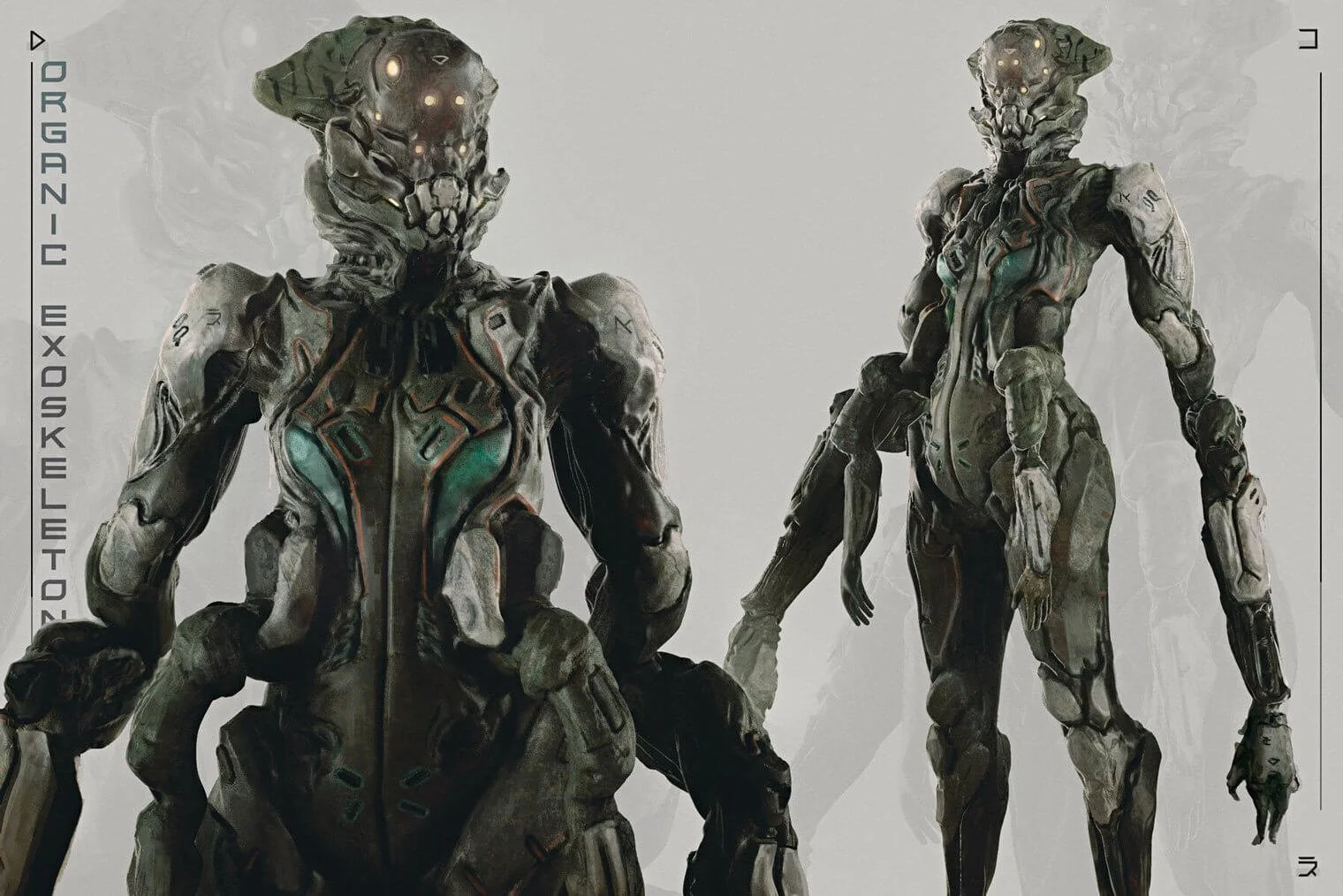
Using tools like ZBrush allows me to sculpt and iterate on forms based on the environment's variables. If the planet has unique environmental settings, I can address gravity first, then re-sculpt and adjust the design incrementally to account for other factors than gravity later.
At the time of writing this, there is currently a lot of buzz around AI and its ability to "finish" an image in seconds. However, the ability to carefully curate, modify, and shape a design manually ensures we aren't fixing "AI mistakes" later. It is always better to design things correctly from the get-go than to apply fixes as if it were digital duct tape.
Photoshop allowed me to focus on painting and testing 3D materials, leveraging the strengths of each software. While perspective is much easier to establish in 3D, certain textures and nuances are often faster to craft in 2D. By bouncing between both, I kept a workflow speed without sacrificing the fundamental principles of concept design.
Picture this: You're building a house to look beautiful, only to realize later that the roof leaks and the structure shakes. It’s the same concept in art: when you build with a strong foundation and respect the core function, the final result will look "right" because it is right.
I’m Miguel Nogueira, a professional freelance concept artist with over a decade of experience in Games and Film. If you have a similar topic you’d like me to research for you and your project, get in touch!